18 April 2008

Fifteen Favorite Fanmixes

As many who know me are aware, I love fanmixes. I think it's a really interesting way to explore themes in shows by finding songs that reflect them, and through cover artwork as well. It's also a great way to find out about new artists- the majority of bands on my iPod I discovered through hearing one of their songs on a fanmix, and then looking up more of their music. So I present to you: my fifteen favorite fanmixes, both my own compilations and others'. Click on album cover to link to each fanmix post.


All of a Sudden, I Miss Everyone: A Jack Harkness Fanmix by


This mix explores the character of Jack Harkness on Doctor Who and Torchwood. It deals with his unique abilities and how he relates to the world and to all the people who've left him behind.


And They'll Never See You Fall: A Tenth Doctor EP by
One of the mixes that I put together. It focuses on the Doctor's brokenness in series three and four of Doctor Who, his difficulties in coping with life without Rose, and the difficulties others have of understanding him.


Broken Things New: A Dexter/Rita Fanmix by
Another mix that I've compiled. This one focuses on the relationship Dexter and Rita have in Dexter, and on the way both of them are emotionally crippled in some way, but still exploring the possibility of being able to love one another.


Cup of Tea: A Doctor/Rose Fanmix by
A collection of quiet songs that reflect upon the Doctor and Rose's relationship.


Ten/Rose - The Fine Art of Falling Apart by
PROBABLY one of my favorite fanmixes ever, and it even comes with some beautiful icons and a wonderful fic! This mix reflects on both Rose's and the Doctor's lives after they are separated in "Doomsday". Wonderful, poignant songs by a great selection of artists.


Happy Phantom: Of Love, Honey, and a Girl Named Chuck by
A cute mix of songs describing Pushing Daisies' Chuck. She's been given a second chance at life by her childhood sweetheart and his abilities to bring the dead to life.


HISS; a Crouch/Lestrange mix by
The beautiful cover art of this mix is matched by the great concept of the "fleeting moments" of the Doctor and Rose. While their traveling together is temporary, there is something eternal in them as well.


Measures of Infinity (or: How I Lost My Heart to Time) by
A wonderfully instrumental compilation focusing on the concept of trying to hold on to forever, in the relationship between Rose and the Doctor.


Nicotine: A House/Cuddy Fanmix
by
This collection looks at the addictive nature of the relationship between House, M.D.'s Drs. House and Cuddy. While they often drive each other away, they are just as often the only person the other can return to.


No Happy Ending by
This mix focuses on the end of Rose and the Doctor's traveling together, and their reflections on their separation.


Pilots Watching Stars: A Post-Doomsday EP
by
Focusing on Rose's learning to deal with her new life in a new universe, this compilation explores her learning to travel on her own.


Running Right Behind You: A Companions Mix by
This mix lovingly looks at the Doctor's companions- at his friendship with them, his loves, his needs, and each of their own unique features.


See My Friends: a Tenth Doctor mix by
Centered around the Doctor's difficulties with relationships in series three of Doctor Who. So sad, but so great.Free Image Hosting at www.ImageShack.us

Take a Walk Around the World by
I had a lot of fun putting this one together- it's all about the journeys Rose takes, from before she meets the Doctor, to long after. Each song has a very short bit of fic with it, showing the various aspects of her travels.


Watching Bridges Burn: A Ten/Rose Playlist by
Are the Doctor and Rose separated forever, or can they find a way back? This compilation is all about the doubts and hopes.

17 April 2008

Clinging Roses and Emasculated Doctors: The Canon and Fanon Criticisms of the Doctor/Rose Ship

There are a lot of people out there who don't like Rose. That's okay. Everybody responds differently to characters. Many of these people write meta on why they don't like Rose, and again, that's okay. I've read several of these posts; some of them have made sense, some haven't. Some have seemed to make sense up until the logic is deconstructed to reveal sentiments of "Rose should be happy staying home keeping her needy mother and ex-boyfriend happy and being domestic," which is a concept that sounds eerily like the "Angel of the House" ideals of the nineteenth century (and beyond) and aspects of the virgin/whore binary, and those aren't things that I can be comfortable with.

But one thing that appears to be a common theme among this demographic of meta-writing Rose-haters is an assertion that Rose is clingy and therefore emasculating to the Doctor, by inspiring him to cling back.

I can understand why someone might get the impression of clinginess, what with things like this:


and this:


But to generalize that she is clingy based on that evidence is to ignore her consistent behavior of NOT being clingy throughout the series.

Let's face it: travel through time and space would be some pretty scary shit. Traveling with the Doctor involves being penniless and homeless in a foreign place or time where you probably won't be the most popular sort of person: a human in alien territory, or a woman in a misogynistic time period. Personally, if I was traveling with the Doctor and knew that he and his TARDIS were the only things ensuring the possibility of my ever getting home or being protected from a nasty death that no one I knew would ever know about, and knowing the Doctor's tendency to get distracted and wander off? You couldn't peel me off him with a crowbar, y'all. Clingy? I'd be hiding inside his coat with a death grip around his waist.

But Rose isn't doing that. In fact, she wanders off just as much as he does. When there's an opportunity to investigate something odd or to help somebody that appears to be in trouble, she follows that. In her first opportunity to travel with the Doctor, in "The End of the World", she goes off to think, and finds herself sympathizing with a mechanic; shortly thereafter, she's kidnapped, leading the Doctor to label her "jeopardy friendly", which describes her rather well. Whether she's running off to find her alternate universe parents ("Rise of the Cybermen"), grabbing a fire extinguisher and going off to explore a spaceship ("Girl in the Fireplace"), or going to explore a freaky child's bedroom ("Fear Her"), she has no idea where she's headed or the dangers involved or who's going to kidnap her this week but she ventures forward anyway, away from the Doctor and the protection he could offer her.

Even when he's not around and she is kind of lost, she isn't paralyzed- she solves problems, even as she wonders not how she is going to be alright, but whether the Doctor is going to be alright. ("Fear Her"- "But who's going to hold his hand now?") When he is otherwise incapacitated, as in "The Christmas Invasion," she steps up to face the threat to her planet, using the knowledge she knows of intergalactic politics.

While she may be close to the Doctor, she's not really that clingy; not as much as she could be. She's like she is because it is her choice- and the fact that she can choose, consciously, shows that she is a strong, independent woman.

And what about the other popular assertion, that Rose is emasculating to the Doctor, because he's always running after her or needing her? I think it is safe to say that he often works to rescue her, such as from the Wire in "The Idiot's Lantern" and from Cassandra's minions in "The End of the World." But does this cause him to be too dependent upon her, and make her nearness and safety the motivating factor of his actions?

I really don't think so. In "The Empty Child," he wanders off and leaves Rose alone in the middle of a German air raid. In "Father's Day" he walks out on Rose and her father. In "New Earth," he doesn't bother to make sure Rose gets in the right elevator (which leads to her possession by Cassandra.) In "Girl in the Fireplace" he leaves Rose on a ship, essentially stranded. In "The Satan Pit" he makes a choice that seems to epitomize all of these behaviors: to defeat the Beast in the pit, he essentially dooms Rose to being sucked into a black hole and killed. However, he doesn't do this because he's uncaring; he is able to make such a difficult decision because he trusts Rose's ability to survive. He is able to make decisions independent of concerns for her safety, because he knows that she is able to take care of herself independently.

However, in the end, they're not independent of each other in their relationship. And that's a good thing! One of the themes of the show is the triumph of human values, such as interconnectivity and relationship. They help each other and bring out the best in each other. While they can be successful on their own, it is the way they each complement the other that allows us to see their best features: Rose's kindness and bravery, the Doctor's intelligence and regard for humans.

In conclusion, I do think that feelings of dislike for Rose in other people are valid. However, if the argument explaining those feelings is not reasoned and supported with canon examples, there is no way for me to consider the argument valid. As far as I can tell from my understanding of the show and what the creators of the show have said, the Doctor/Rose ship makes sense, and is textually supported.

Yeah, bitches. I just pwned you all like only an English major can.

Literature and Lattes

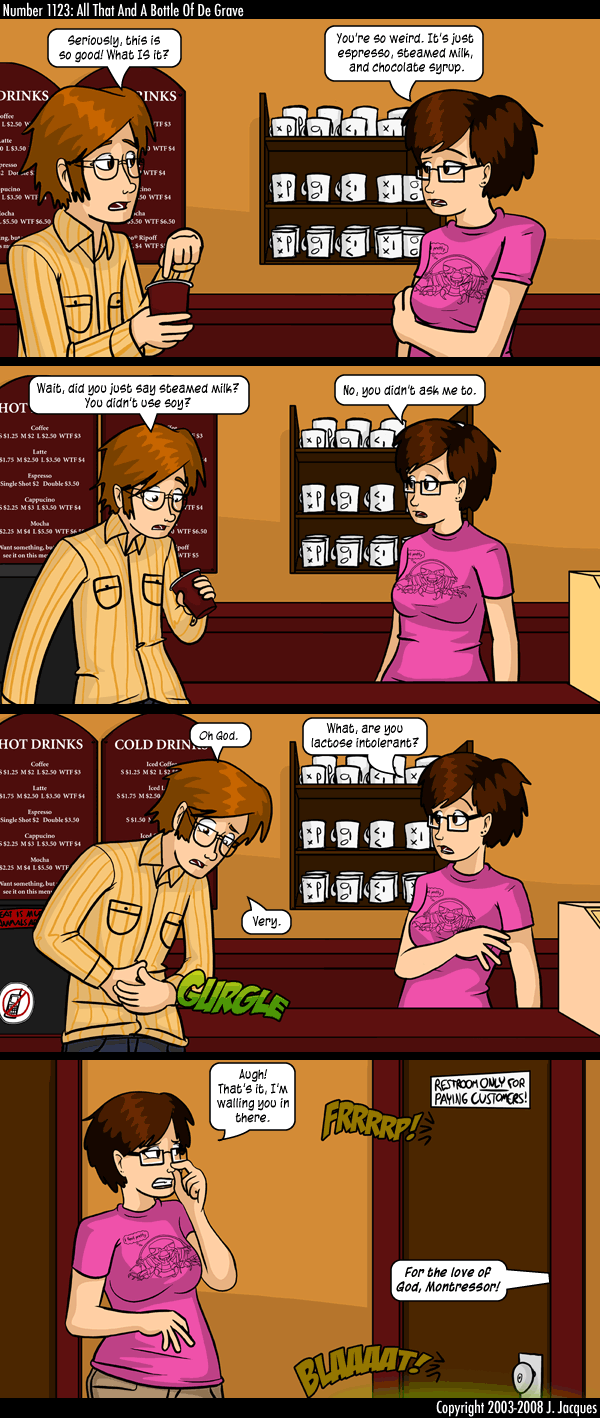
Seriously, Questionable Content is always awesome, but today? Is just the best. (Click to see it bigger and, possibly, readable.)


12 April 2008

A few thoughts on the BBC's Doctor Who image gallery. Which is also a laugh, and usually needs a good copyeditor. *volunteers*

OMG GUYS. Guys. Y'all. I am nearly done downloading the second Doctor Who ep this season. I like this world where there is new Who! I also am scared! What if something awful happens and fandom explodes again?

To help my suspense, I went to the BBC Doctor Who site. Of course.

They have this new game up! About how far in time you can fly the TARDIS in the vortex. It sounds really cool! Except there was this one time I played the Christmas Special game about how many aliens you can identify and freeze or something and I ended up destroying the world and having the website!Doctor telling me I was a really rubbish companion. It totally broke my heart and made me cry jaded me against playing any more games on the site. I also think my US IP address will block me from playing, too.


There are so many pictures of the Doctor looking really disturbed and traumatized. I think this may be Donna's effect? It is kind of funny, but it also looks like he doesn't know where the walls of his universe are anymore. Series three, it keelz.


More trauma!face. Also: why the Blue Suit of Doom? Whyyyyyy? It makes him look skinnier and boxier than he already is, and it usually makes his hair look sad. However, I am TOTALLY with the Browncoat love here.


And with the Browncoat look here. Donna, rock on. IT IS TOTALLY TIME FOR A CANON FIREFLY CROSSOVER. Ohmygod, BBC, please. It'd be like Joss and Rusty's lovechild.


I like that top, Donna. Kinda ehhh about the hairdo, but it's a pretty top.


Oh, Donna. I kind of love you. Not the way I love Rose, not "OMG you are so cute and hot and need to be grinning on my computer screen at all times if not actually hugging the Doctor" but my Donna-love is more like for a big sister. Like, I want to sit around watching movies and commiserate about the complications of having stupidly large boobs, and why guys don't fancy us more than they do but we don't need them anyway, and making plans for trips we'll never take.


Oh, Doctor. Don't look so panicked. DD-cups are scary, but not that frightening. I mean, reserve that face for the triple-Ds at least, right?


"Just because I am mimicking his oh-so-important-Timelordy crossed-arms stance and suit, doesn't mean I am holding back giggles! I am not being ironic at all."


"Donna. They're watching us. Through that box there."
"...I know."


And, to end:


"Look what I did with MY eyeliner pencils, guys! And my mum's Christmas tablecloth."

Oh, Beeb. You're so cute. And so is your special effects budget.

25 March 2008

Joss Whedon as Film Auteur

I really hope that one day I get a chance to write a paper arguing that Joss Whedon is a film auteur. I've been reading about the French New Wave critics, and auteur theory, and their views on Hitchcock and all that- and from what I understand of the definition, I think Whedon's work really defines him as such.

The most simple, encompassing definition I have seen so far is in Marilyn Fabe's An Introduction to the Art of Narrative Film Technique, which says that auteurs have a "unique style and vision [that] mark their films" and that "according to the French critics who defined the term, even when an auteur makes a work based on some else's novel, drama, or screenplay, he somehow manages to inscribe upon it his own thematic concerns."

Joss, of course, is best known for his series Buffy the Vampire Slayer, Angel the Series, and Firefly/Serenity. What themes and concerns come across most strongly in all of these? Things like real families vs. chosen families; the inability for two people in love to have a perfect relationship; free will vs. a pre-programmed destiny; women who say the awkward-but-true things about situations; the prevalence of father-figures over real fathers; a setting that has just as much characterization as one of the actual characters; use of extraordinary situations to explore ordinary issues.

He also wrote the screenplay for Toy Story. Where Woody and Buzz struggle to understand the meaning of their chosen family of the other toys, and their place in it- and their value to their adopted "father," Andy. Where Woody struggles with the issue of will he be a favored toy, or is he destined to be pushed under the bed and forgotten? Bo Peep, I think, fills the role of Cordelia in Angel, or Anya in Buffy- to be both the truth-teller and comforter. The oversized world of the bedroom and Andy's house is just as characterized as the ship Serenity, or the Hyperion Hotel. Though not the director of the film -the typical film auteur- I think it can most definitely be argued that he has imprinted many of the same concerns and themes on Toy Story as he does on his other works.

Even in Disney's Atlantis: The Lost Empire, for which Whedon only wrote a treatment, the same themes return again. Milo Thatch and the crew of explorers struggle with their bond to each other vs. their treasure-seeking expedition. Atlantean princess Kida, unfamiliar with the surface world and its social norms, asks the same questions that River or Anya might ask to get an explanation for a situation. The Shepherd's Book that guides the explorers to Atlantis and the writings on the city itself are a lore and prophecy that challenge ideas of free will and determinism, much like the situation that Buffy found herself in, as the chosen Slayer. The absent father theme comes up again, as Milo's grandfather proves to be far more of a presence and influence on Milo's life.

While most of the auteur information I'm coming across is in regards to Francois Truffaut and Alfred Hitchcock, I think that Joss Whedon does fit into this category of filmmaking. I just wish he'd be a little more prolific! (But I hear Dollhouse and Goners are a go, sometime, though!)

20 March 2008

T-minus 16 and counting... Doctor Who series four is a go...

The Beeb, at long, long last, released the starting date for series four of Doctor Who this year. It probably killed them a little bit! While I'm pretty sure Fox has already scheduled episodes of 24 for next frakkin' year, the BBC can just barely be coaxed to tell starting dates for one of its most popular shows.

Actually, we don't even have show time yet. (Although seven p.m. is a safe bet.) This, of course, is for those lucky folks who actually live in the UK and can watch it at the time it comes on, instead of waiting to download it sneakily or find out when or if PBS or SciFi will air the episode.

I'm looking forward to this series with a lot more optimism than I was feeling at this time last year. After the first two series, where I met the Doctor, lost him as he changed into someone with a new face and grew to know him even better, and where I met and fell in love with Rose Tyler, his companion, the London shopgirl who had such a curiosity and sense of adventure as she traveled through time and space, and such a big heart. They traveled the universe in the TARDIS, saving the world and each other over and over again.

And then Rose was lost to another universe.

Of course she wasn't the first human the Doctor picked up to travel with him. Of course she's strong enough to make a life for herself. But still- it's better with two.

Christmas Special- "The Runaway Bride". Donna Noble, in her wedding gown, mysteriously appears on the TARDIS moments after the Doctor has had his heart ripped out and stomped on by emus. She patches up his wounded soul by screeching at him and calling him a Martian, and demanding he take her back to her wedding, since he obviously kidnapped her. Though bemused, he tries to take her back, things get complicated, they save the world, Donna realizes the world is bigger than chips and telly, but refuses to travel with the Doctor: he has a darkness in him, she says, and he needs someone to stop him sometimes.

An unspecified amount of time later, he picks up Martha Jones, medical student, who immediately develops passionate unrequited love for him, and completely fails to stop his darkness. The Doctor is offered many things in series three- a normal life, a wife, one of his own kind- but none of them satisfy, and it only emphasizes his lack of Rose's temperance all the more. When Martha learns to love adventure and realizes she cannot stand in the shadow of either Rose OR the Doctor anymore, she leaves, promising that she will keep in touch.

Series four- it's commonly known that Donna (played by the incomparable Catherine Tate) will be returning as the companion, and I completely embrace this. She won't moon over the Doctor. She won't stand for his shit. She'll stop him when he tries to play god. She'll balance the extraordinariness of traveling to distant times and places with the ordinariness of just wanting a damn cup of tea. At least, that's what I'm hoping. If Russell T. Davies and the Writing Team of Occasional Awesome can keep their shit together, and not jump the shark like a lot of shows do in season four (Angel, folks. Alias. Things start to make no sense whatsoever.) And there are a few other things that are happening that I just can't WAIT to see.

April fifth! That's not too long!

02 March 2008

Juno vs. Realism

I went to see Juno this weekend. Mum wanted to hang out, my friends said it was good, Ellen Page has rocked my socks a bit for a while, and it was a pretty enjoyable movie, all in all. I liked it quite a bit, and fangirled most everything Juno said. ("I still have your underwear." "I still have your virginity.")

But then in the car, the discussion started. Grandma, who often has a let's-just-call-it-unique perspective on life, decried the lack of realism. "Juno's parents were too calm about her being pregnant. And that boy who liked her- like he would still want her after she got pregnant?" I patiently explained that I thought part of the whole point was that Juno was not the norm; that was her appeal, how quirky and unique she was. And that, while Paulie Bleeker may have liked Juno even when she was pregnant, he did basically nothing to help her, so how was he violating the norm, again? And, most of all, I think there was a definite reason for not seeing Mac and Bren Macguff's reaction to Juno being pregnant, as well as for not showing any emotional aftereffects for Juno, giving up her baby: that wasn't actually the story.

As far as I can tell (having seen the movie only once,) anything could have happened to Juno, other than getting pregnant. She could have gotten in a car accident and been paralyzed. She could have had some sort of disease. She could have been orphaned, sent to live with a crazy aunt in West Virginia. Whatever. The story here is that

1. Juno is a quirky, independent young woman.
2. Juno has a problem that could drive her into shame, isolation, and a dead-ended life.
3. Juno, keeping in line with her quirky, independent nature, seeks for solutions to her problems.
4. Juno, in the process, learns much about who she is and isn't, what she wants from life, and the nature of relationships.

And that's it. It's Juno, that's what the movie is called. Not What Mac and Bren Thought About Juno Getting Knocked Up. Not The Importance of Being Pro-Life. Not Girl, Keep Your Legs Crossed.

It's just a movie about a girl. And there is realism, actually; there's realism where a female protagonist doesn't have to be perfect to be normal; she doesn't have to be incredibly sexy AND smart AND have all the guys after her AND a few interesting childhood traumas to be the status quo woman. She can be okay in school, have a few friends, not always make the best decisions, and still be someone that we can love, because she's herself and no one else.

So some details are oversimplified. Fine. You want that stuff to be explored? Go make your own movie. But don't forget that Juno is no one but herself.

* * *
Juno MacGuff: You should've gone to China, you know, 'cause I hear they give away babies like free iPods. You know, they pretty much just put them in those t-shirt guns and shoot them out at sporting events.
* * *
Vanessa Loring: You think you're really going to do this?
Juno MacGuff: Yeah, if I could just have the thing and give it to you now, I totally would. But I'm guessing it looks probably like a sea monkey right now and we should let it get a little cuter.

* * *
Su-Chin: I'm having a little trouble concentrating.
Juno MacGuff: Oh, well, I could sell you some of my Adderall if you want.
Su-Chin: No thanks, I'm off pills.
Juno MacGuff: That's a wise choice because I knew this girl who like had this crazy freak out because she took too many behavioral meds at once and she like ripped off her clothes, and dove into the fountain at Ridgedale Mall and was like, "Blah! I am a Kracken from the sea!"
Su-Chin: I heard that was you.

01 February 2008

"I wonder sometimes about the outcome of a still verdictless life... why, Georgia, why?"

"People come to Georgia for two things: Gone With the Wind and Martin Luther King, Jr. But you have to have both- neither means a thing without the other. They seem like they contradict each other, but without the story that Gone With the Wind tells, Martin Luther King has no context; without Martin Luther King, Gone With the Wind is just another Southern myth," said my film teacher, Dr. King, once.

I don't think he was wrong. Georgia, and the South as a whole, is a strange place, full of dichotomies, juxtapositions, and contradictions. One of the big issues, of course, is race; with our history, the relationship between white people and black people is something that always seems to come to the forefront. And it seems like everyone, whether they are conscious of it or not, whether they want to or not, whether they have more melanin in their skin or less, operates and thinks at least sometimes based on racial prejudices. I'm sure I'm far from the only girl who's been told, "Don't you bring a black guy home!" And one of my best friends, Katrina, has told her son not to date a white girl when he grows up, because if they break up and White Girl's unhappy about it, she could cry rape and be believed. (Which is probably-most-likely true.)

But on the other hand, I think most people I know are proud of the diversity they see here. I remember when my friend Shelley moved from a somewhat-urban school in south Marietta to a more rural one in north Woodstock. She couldn't stand it; she'd had many friends, black, white, and otherwise in Marietta, and the move to a predominantly white school came with too much irritating homogeneity. (She's a blond and white, by the way.) I feel much the same way- I absolutely want to live places with people coming in all colors. I know that in New Hampshire, the black population is about 2%. I think I'd be a little blinded by the white. I know that, at least around here, the smaller and more rural the town, the whiter and less tolerant it seems to be. And maybe I love to go visit Elijay for the apple festival, but I couldn't fathom living up around there. This is part of why I want so much to live in a city- I often don't fit in, so I want to find places with more diversity, not less, diversity of all sorts: intellectual, ethnic, creative.

But Southern dichotomies aren't just about race, of course. There are politics as well. Maps always show us as the Red States, full of Republicans and conservatives. Part of that is because of the Bible Belt, the solid streak of Baptist churches lined up across our portion of the country. Despite the strong religious leanings, though, the conservative stance is to be against things like social programs, and for things like nationalism- strange, considering Jesus told people to share their goods with those who had none, and urged his followers to pursue an alternative social system with unlikely power structures. As Flannery O'Connor said, "While the South is hardly Christ-centered, it is most certainly Christ-haunted." I guess we tend to endorse Republican candidates, because they are more likely to say, "Jesus told me to run, and cut taxes, and not develop healthcare, and to Be American." I guess the name impresses us.

At the same time, though, but on a lower level, people are kind, here. They're polite. From what I've noticed from limited comparisons with people from places like Ohio or Michigan or other chillier states, Southerners are more tactful and don't greet people in a way that sounds like an insult. We say y'all instead of you guys (you guys being a phrase that offends that inner feminist I have stuffed back here somewhere.) We call people ma'am and sir if they're possibly older than us, or
even really for no reason at all. No, it's not the saving-the-world variety of goodness. But there is goodness, and lots of it.

Guns- the right to bear arms- another issue. People that wouldn't want a gun in their house will loudly assert their Constitutional right to have one. As far as I can tell, one of the original reasons for that right was so that the government would know its populace was armed, and not overstep its bounds and thus piss off said armed populace. At this point in time, though, no one would dream of getting together a bunch of people with firearms and taking down the government, no matter how high taxes were raised. But maybe we like to think we could, if we had to.

There are so many myths taking up space in people's heads that create these contradictions. The grand story of the happy antebellum past, a golden age of sorts. The epic civil rights movement, as half the population struggled for equality and respect. The underdog story of the South's defeat by the industrialized, uncaring North, and how it had to rebuild itself. "The Devil went down to Georgia, he was looking for a soul to steal." The shameful confession of all the things that were Not Good. Gone With the Wind and Martin Luther King Jr.

One of the reasons I've been thinking about this lately is because of my plans to move to Scotland. My (Canadian) flatmate-to-be asked if I wouldn't prefer somewhere in the south of England, since I was used to being Southern and all, and answered that I am definitely sure that no, I wouldn't. I sympathize with Scotland and its nationalism and possibly movement towards independence. It's not that I think the South should attempt to secede again or that we should institute the Stars and Bars flag, not by any means. But I've seen and heard the English prejudice towards and bemusement about Scotland- that it's weird, rural and undeveloped, that the people aren't understandable, that somehow being British but not being English is just... abnormal. Doesn't that sound familiar? Isn't that the perception given of the South from movies, the media? Just... bemusement. A lack of comprehension of why we're not classified as one thing or another, and thus we're drawling cooks of unhealthy food, or sheet-wearing Klansmen, or living in trailer parks making moonshine and playing "Dueling Banjos," or dying of critical stupidity as indicated by our SAT scores. We're Southern, so we're not normal, we're just... Other.

And maybe that's why Georgia literature, Flannery O'Connor and Carson McCullers and so on, seems so schizophrenic, zooming from one extreme to another, telling the stories of outsiders and misfits. Showing the lives of those that can't be put into easy categories, that are almost painful to read because of the difficulty of description.

Still, we resist cultural leveling where we can. We hold on to our conglomeration. "Be proud you're a Rebel 'cause the South's gonna do it again!" sings Charlie Daniels. Do what, precisely? Oh, nothing in particular. But still, we're proud, aren't we? And we'd rather be us than anything else. Even if that's something like Chattahoochee Tech sharing their campus with a trailer park, a sight I saw today.

So the myths go on, against each other and needing each other, and there are no conclusions to be had. But when is there, in life? We go on.